Website-Einstellungen

Lager
Spracheinstellungen
Währungseinstellungen
Produkte
Informationsmaterial
Video-Bibliothek
Cx Family Common Mode Chokes
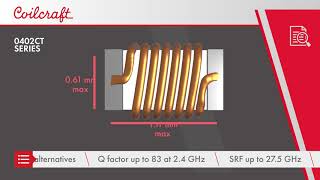
0402CT Low Profile Chip Inductors
Inductors Explained by Coilcraft & Mouser
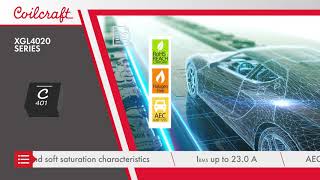
XGL4020 Ultra-low DCR Power Inductors

TLVR Multiphase Magnetics

Magnetics for Multiphase / Multiphase TLVR

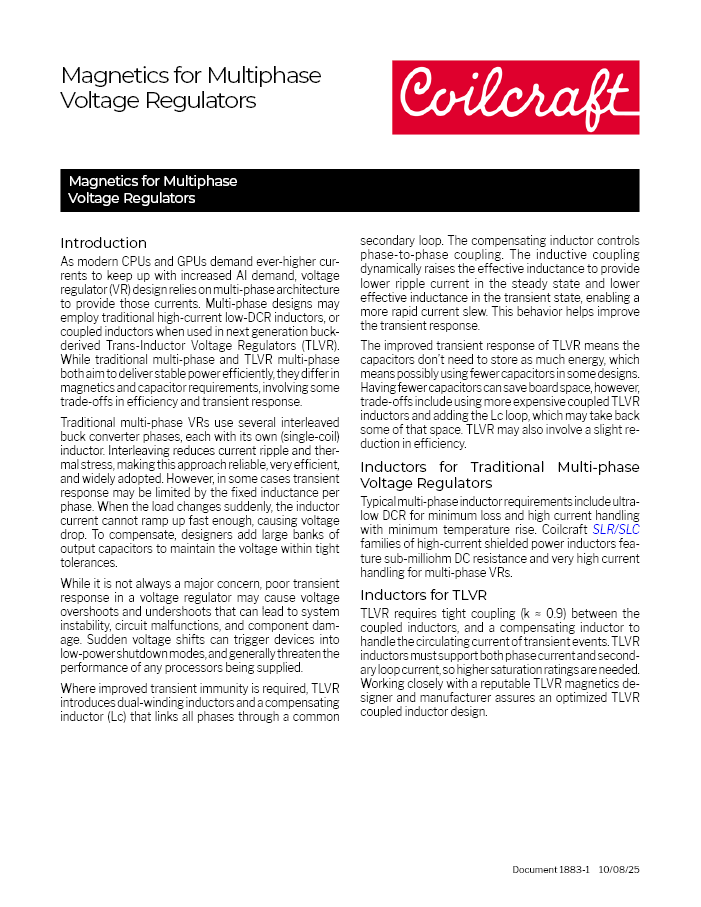
As modern CPUs and GPUs demand ever-higher currents to keep up with increased AI demand, voltage regulator (VR) design relies on multi-phase architecture to provide those currents. Multi-phase designs may employ traditional high-current low-DCR inductors, or coupled inductors when used in next generation buck-derived Trans-Inductor Voltage Regulators (TLVR). While traditional multi-phase and TLVR multi-phase both aim to deliver stable power efficiently, they differ in magnetics and capacitor requirements, involving some trade-offs in efficiency and transient response.

Magnetics for Multiphase Voltage Regulators

Traditional multi-phase VRs use several interleaved buck converter phases, each with its own (single-coil) inductor. Interleaving reduces current ripple and thermal stress, making this approach reliable, very efficient, and widely adopted. However, in some cases transient response may be limited by the fixed inductance per phase. When the load changes suddenly, the inductor current cannot ramp up fast enough, causing voltage drop. To compensate, designers add large banks of output capacitors to maintain the voltage within tight tolerances.

While it is not always a major concern, poor transient response in a voltage regulator may cause voltage overshoots and undershoots that can lead to system instability, circuit malfunctions, and component damage. Sudden voltage shifts can trigger devices into low-power shutdown modes, and generally threaten the performance of any processors being supplied.

Where improved transient immunity is required, TLVR introduces dual-winding inductors and a compensating inductor (Lc) that links all phases through a common secondary loop. The compensating inductor controls phase-to-phase coupling. The inductive coupling dynamically raises the effective inductance to provide lower ripple current in the steady state and lower effective inductance in the transient state, enabling a more rapid current slew. This behavior helps improve the transient response.

The improved transient response of TLVR means the capacitors don’t need to store as much energy, which means possibly using fewer capacitors in some designs. Having fewer capacitors can save board space, however, trade-offs include using more expensive coupled TLVR inductors and adding the Lc loop, which may take back some of that space. TLVR may also involve a slight reduction in efficiency.

Inductors for Traditional Multi-phase Voltage Regulators

Typical multi-phase inductor requirements include ultra-low DCR for minimum loss and high current handling with minimum temperature rise. Coilcraft SLR / SLC families of high-current shielded power inductors feature sub-milliohm DC resistance and very high current handling for multi-phase VRs.

Inductors for TLVR

TLVR requires tight coupling (k ≈ 0.9) between the coupled inductors, and a compensating inductor to handle the circulating current of transient events. TLVR inductors must support both phase current and secondary loop current, so higher saturation ratings are needed. Working closely with a reputable TLVR magnetics designer and manufacturer assures an optimized TLVR coupled inductor design.

SLV9080 Series of off-the-shelf shielded 1:1 coupled inductors for TLVR. Inductance values range from 50 nH to 200 nH with a saturation current rating as high as 120 A at 25°C ambient. They come in a compact 9.15  ×6.4 × 8.53 mm max package size.

SLV1211 Series of off-the-shelf shielded 1:1 coupled inductors for TLVR. Inductance values range from 70 nH to 200 nH with a saturation current rating as high as 152 A at 25°C ambient. They come in a compact 12.2 × 6.2 × 11.3 mm max package size. 
Coilcraft also has extensive experience in the design of customized TLVR inductors for customers with unique dimensional constraints or performance requirements.

doc1883_tlvr_thumbnail.png
View this TLVR App Note as a PDF

Type

Image Inductance Range Current Rating
at 25°C 
Package Size Series
TLVR slv9080.png 50 — 200 nH up to 120 A 9.15 × 6.4 × 8.53 mm SLV9080
TLVR slv1211.png 70 — 200 nH up to 152 A 12.2 × 6.2 × 11.3 mm SLV1211


Conclusion

Multi-phase VRs remain a solid choice for many CPU/GPU applications due to simplicity and maturity. The simplicity of using a discrete inductor for each phase leads to lower cost and high efficiency. Where improved transient response is needed, TLVR offers a compelling alternative.


Doc 1883

Questions or Concerns?

Ask View FAQs


General Applications

Handling and Processing

RF Inductors

Power Conversion

EMI/RFI Filtering

Special Applications