Power over Coax (PoC) technology combines the transmission of both power and data over a single coaxial cable, significantly reducing the amount of wiring needed to accomplish both the power and the data/control functions. PoC networks simplify the wiring, reduce the required wiring space, and reduce the overall weight of the combined power and data systems.
With multiple vehicle sensors and systems, the wire network weight savings of PoC translates into significant milage savings when used for automotive applications such as an Advanced Driver Assistance System (ADAS), driver monitoring, autonomous driving, and infotainment systems. In commercial and industrial applications, the labor-saving wiring and elimination of required AC power outlets can reduce installation costs.“Magnetics”, i.e. inductive components such as power injection inductors, play an important role within the bias tees that combine DC (power) and AC (data signals) on one end of a coaxial cable and separate the data from the DC power at the other end of PoC systems. Proven reliable PoC filter solutions save design time and simplify PoC system design.
Low voltage differential signaling (LVDS) is a high-speed, low-power data transmission standard with low electromagnetic emissions and high noise immunity, making it well-suited for high-resolution image data transmission, such as in ADAS camera systems.
In a typical ADAS, a high-speed video serializer/deserializer (SERDES), such as an FPD-LinkTM or GMSL2TM interface, converts a high-resolution camera’s parallel data to a serial format for transmission over the coax cable. The deserializer performs the reverse function, converting the serial data back to parallel for processing at the other end of the cable. Power is needed for the camera, deserializer, serializer, and the camera’s image sensor. A bias tee is used at both ends of the cable to inject and extract the power where it is needed.
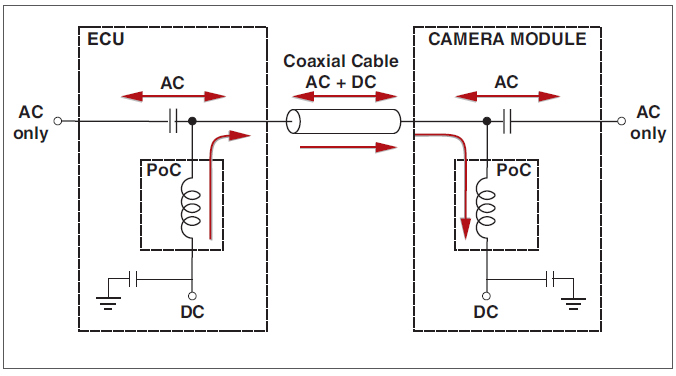
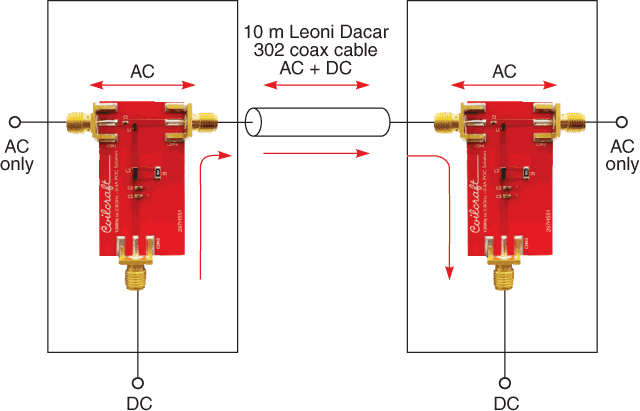
As illustrated in Figure 1, the electronic control unit (ECU) and ADAS camera module are connected by a coaxial cable which carries both the camera control signals and the power to drive the camera. On the ECU side of the PoC system, DC (power) is injected onto an AC signal (data) using a bias tee. This power is transferred via the cable to the other end, providing (DC) power to the camera module (power regulator) while isolating the (AC) communications and data signals from the DC source. Isolation of the AC and DC prevents signal distortion and protects image quality. On the camera module end, another bias tee is used to extract the DC to power the camera and communications.
.png "PoCDiagram-(11).png")
Figure 1 – Bias Tees in Power over Coax Applications
Ideal inductors would perfectly isolate DC from AC components, however, the performance of real inductors is not ideal due to parasitic resistive and capacitive effects. To obtain reliable circuit function, proper selection of power injection inductors for PoC filter solutions requires low insertion loss and high return loss over the entire frequency spectrum of the PoC system.
To maintain signal integrity and a good signal-to-noise ratio, these low-pass PoC filter solutions must be designed for high impedance (typically > 1 kOhm) compared to the lower (50 Ohm) characteristic impedance of the channel. This high impedance must be maintained over the full frequency range of the PoC system, requiring multiple inductors and other (R, C) passive components to achieve optimal performance. The PoC network must have a high enough current rating to allow the required current to be supplied to the powered devices. In addition, to preserve signal integrity the filter solution must be capable of passing the desired current without saturating the inductor(s) or exceeding the ratings of any of the filter components.
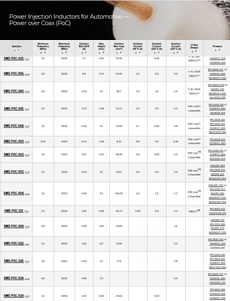
Coilcraft has pre-engineered a broad selection of PoC solutions, each minimizing the required board space while maintaining high return loss and low insertion loss over a wide frequency range. These solutions are all optimized for high-resolution and high-frame-rate cameras for existing and future Advanced Driver Assistance Systems (ADAS) and are pre-engineered for compliance with GMSL and FPD-Link SerDes-based Gigabit serial communication standards.
Coilcraft PoC solutions support current levels ranging from 300 mA to 1200 mA, covering popular SERDES application spectrums with up to 5.3 GHz bandwidth.
Selecting an optimized PoC filter solution may begin with identifying the worst-case ambient temperature and current requirements. Another consideration is the frequency bandwidth over which the impedance must be high.
For example, for 125°C ambient and 450 mA current, Coilcraft’s SMD-POC-069 is a small-footprint off-the-shelf bias tee reference solution that meets these temperature and current requirements and is FPD-Link™ compatible.
It covers a wide bandwidth from 25 MHz to 4200 MHz, capable of high-speed video SERDES data transmission while simultaneously passing DC to the powered device (e.g. camera module).

SMD-POC-069 450 mA Solution
PoC technology provides more compact, cost-saving solutions than traditional wiring. These solutions can have a significant impact on vehicle weight and milage improvement in automotive applications. Selecting the right inductive components is essential for optimizing PoC filter solutions. Having fully-tested, off-the-shelf PoC filter solutions available significantly reduces design time that can be used to focus on other design elements.