Why Single Pair Ethernet (SPE)?
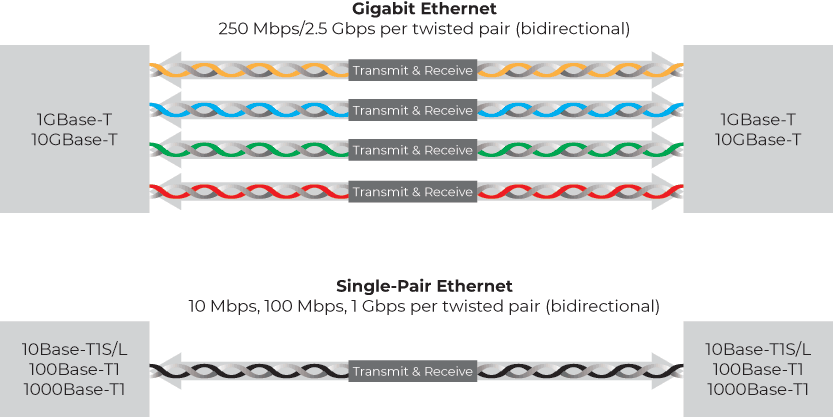
Single Pair Ethernet (SPE) is a networking technology that utilizes a single twisted pair of wires for communication. Traditionally, Ethernet connections have used multiple pairs of wires, but the demand for more compact, lightweight solutions has led to the development and adoption of SPE.
SPE is designed to provide reliable, high-speed communication over a single pair of conductors, making it well-suited for applications where space is limited and/or weight is a critical factor. It supports various data rates, including 10/100/1000 megabits per second, commonly referred to as 10/100/1000BASE-T1.
Single Pair Ethernet Standards
| Standards |
IEEE Specification |
Data Rate |
Distance Range |
| 10BASE-T1S |
IEEE 802.3cg |
10 Mbps |
Up to 25 m |
| 10BASE-T1L |
IEEE 802.3cg |
10 Mbps |
Up to 1000 m |
| 100BASE-T1 |
IEEE 802.3bw |
100 Mbps |
Up to 15 m |
| 1000BASE-T1 |
IEEE 802.3bp |
1000 Mbps |
Up to 40 m |
| NGBASE-T1 |
IEEE 802.3ch |
2.5 / 5 / 10 Gbps |
Up to 15 m |
10BASE-T1L Solutions — 10 Mbps Long Reach
What is 10BASE-T1L?
10BASE-T1L is a SPE standard defined by IEEE 802.3cg. It is designed for long-distance communication, supporting up to 1,000 meters at 10 Mbps over a single twisted pair cable. This makes 10BASE-T1L an ideal solution for industrial automation systems, building automation and long-distance sensor in IoT networks.
Typical Applications — 10Base-T1L with Power over Data Lines (PoDL)
A key feature of 10BASE-T1L is its ability to support Power over Data Lines (PoDL), where both data and power are transferred over a single twisted pair. This significantly reduces wiring complexity and installation costs in systems such as:
- Industrial sensors (temperature, pressure, flow)
- Building automation (lighting, HVAC, monitoring)
- Remote I/O modules and smart actuators
Figure 1 is a block diagram of a typical 10Base-T1L system using PoDL in industrial, building and factory automation applications.
The system consists of a Physical Layer (PHY) device on both the controller and sensor side, Power Sourcing Equipment (PSE), a Powered Device (PD) and the power/data transmission section between the two.
- PHYs (on both sensors and controller sides): responsible for encoding and decoding Ethernet data signals to accommodate long-range, low-power communication (up to 1,000 meters).
- PSE (Power Sourcing Equipment): supplies power to remote PD device through the same twisted pair used for data communication.
- PD (Powered Device): receives both power and data from the PSE over the same twisted pair. In 10Base-T1L with PoDL applications, it is typically a low-power industrial or building automation device that requires both power and data communication over a single twisted pair.
- Common mode choke (CMC): attenuates common mode noise while allowing differential Ethernet data signals to pass through.
- Power injection choke (PIC): injects DC power onto the data line while allowing AC Ethernet signals to pass through without distortion. Typically it is placed in series with the differential pair on the PSE side to ensure efficient power transfer. It also can be used on the PD side to extract DC power from the data line.
- Isolation transformer (ISO XFMR): provides galvanic isolation between the Ethernet PHY and the cable. This is only required when safety is critical and isolation is needed for the application.
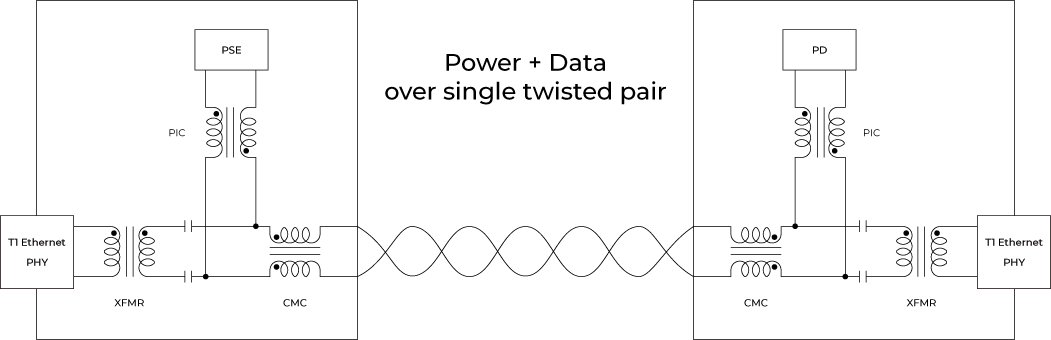
Figure 1 – 10BASE-T1L with PoDL System Block Diagram
10Base-T1L can also be implemented without PoDL, only for data transmission. In these applications, the system would only transmit Ethernet data over a single twisted pair, without injecting DC power onto the same line. A single common mode choke is required to filter out common mode noise and reduce EMI (Figure 2).
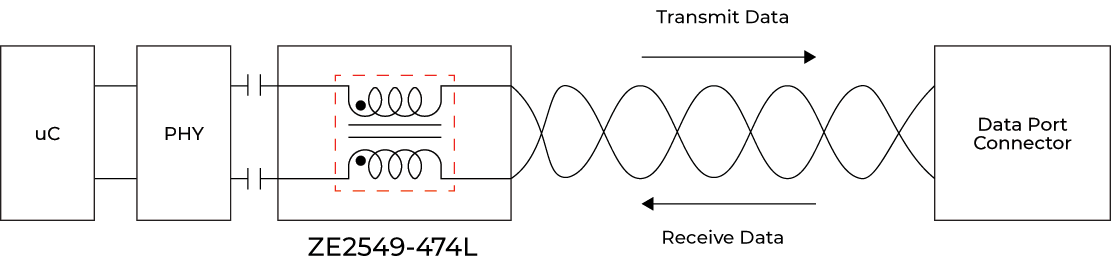
Figure 2 – Implementation of 10Base-T1L for data-only transmission
Coilcraft Recommended Products
Our 10BASE-T1L solution portfolio is designed to meet the meet IEEE 802.3cg standards. To validate the performance of these components in 10BASE-T1L PoDL applications, the schematic in Figure 2 was implemented. Return Loss (Sdd11) (Figure 3) and Insertion Loss (Sdd21) (Figure 4) were generated.
| |
Part Number |
Inductance |
DCR max (Ohms) |
Irms both winding (mA) |
Max Temp (ºC) |
| Isolation Transformer |
ZE2531-105 (2000 Vrms Isolation) |
1 mH |
0.185 |
1000 |
140 |
| Power Injection Choke |
MSD7342-224 |
220 µH |
1.7 |
300 |
125 |
| MSD1048H-224 |
220 µH |
0.92 |
450 |
165 |
| MSD1278H-224 |
220 µH |
0.54 |
1000 |
165 |
| Common Mode Choke |
ZE2549-474 |
470 µH |
0.17 |
910 |
140 |
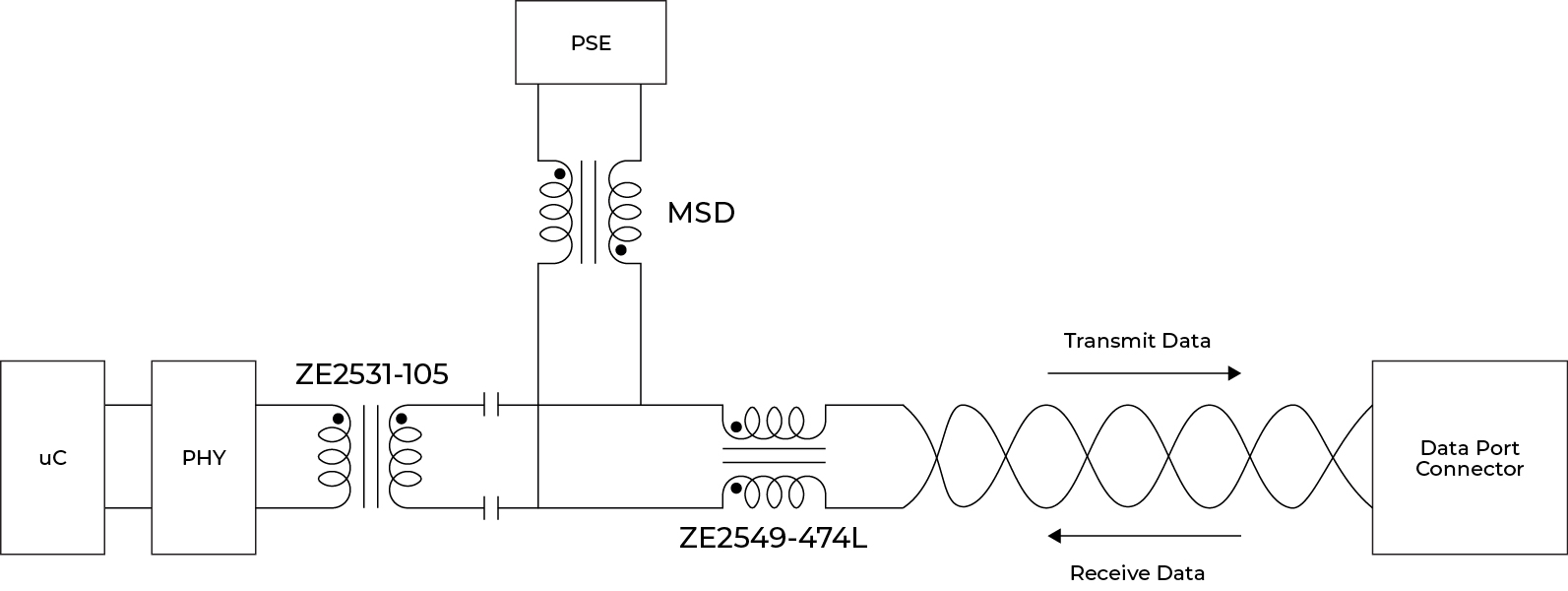
Figure 2 – Schematic Used to Evaluate Coilcraft’s solution in 10BASE-T1L PoDL
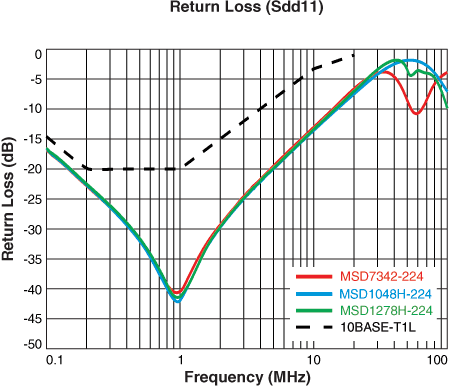
Figure 3 – Return Loss
|
|
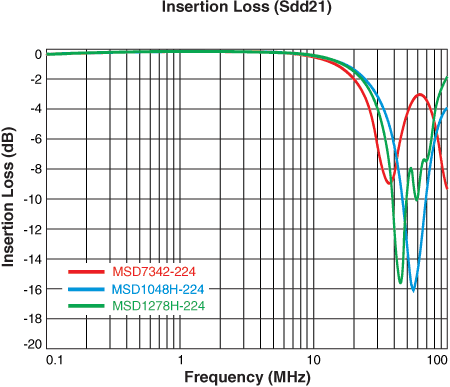
Figure 4 – Insertion Loss
|
10BASE-T1S Solutions — 10 Mbps Short Reach
What is 10BASE-T1S?
10BASE-T1S is a Single-Pair Ethernet (SPE) standard that utilizes a bus technology with multidrop nodes from a single cable. By implementing Power over Data Line (PoDL) technology via SPE, you not only eliminate the multiple cables and switches needed for standard 802.3 applications, you also eliminate the additional power cables to the nodes on the bus.
Traditional 802.3 Ethernet systems utilize an isolation transformer between the cable and PHY (physical layer) chipset. In Power over Ethernet (PoE) applications, the center tap of the transformer is used as the delivery and return path of the power. While an isolation transformer can still be implemented in PoDL, it is not required.
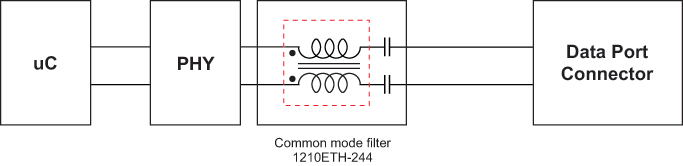
Figure 6 – PoDL solution does not require a transformer for isolation
The schematic in Figure 6 shows that a single common mode choke and two capacitors are all that is required for isolation in PoDL. PoE applications use one bus pair for data delivery and another pair for the power return path. Unlike PoE, PoDL employs differential power injection using a single-pair bus for both the power delivery path and the return path (Figure 7).
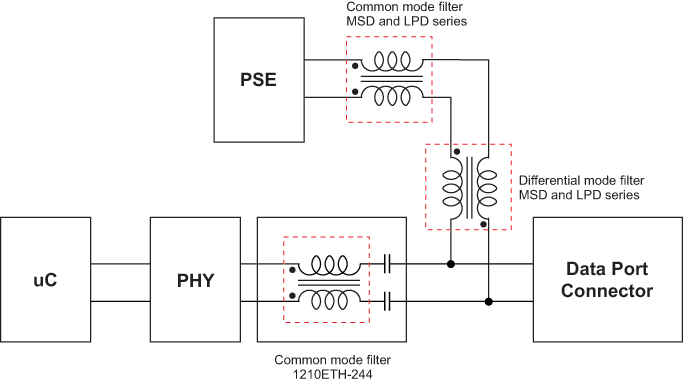
Figure 7 – PoDL power injection is differential using a single bus
| Inductors |
DCR
max. (mOhms) |
Max. Area (mm2) |
Isat (A) 30% |
Irms both windings |
SRF (MHz) |
Turns Ratio |
Capacitance |
Max Temp (°C)
|
AEC Grade |
Application |
| LPD4012-333 (33 µH) |
1830 |
16.0 |
0.58 |
0.31 |
12 |
1:1 |
27.4 |
125 |
– |
For ~0.30 A |
| LPD5030-333 (33 µH) |
565 |
23.04 |
0.78 |
0.60 |
16 |
1:1 |
37.5 |
125 |
3 |
For ~0.60 A |
|
MSD7342-333 (33 µH)
|
270 |
56.25 |
1.7 |
0.76 |
11 |
1:1 |
32.9 |
125 |
3 |
For ~0.75 A |
| MSD1260T-333 (33 µH) |
134 |
151.29 |
4.5 |
1.64 |
12.4 |
1:1 |
91.4 |
165 |
1 |
For ~1.5 A |
The 33 µH Coilcraft components in this table can be used as both the common mode and differential mode filters shown in Figure 2. Specific selections are based on the desired injected current level.
Space-saving Differential Power Injection Inductors and Common Mode Chokes for 10BASE-T1S
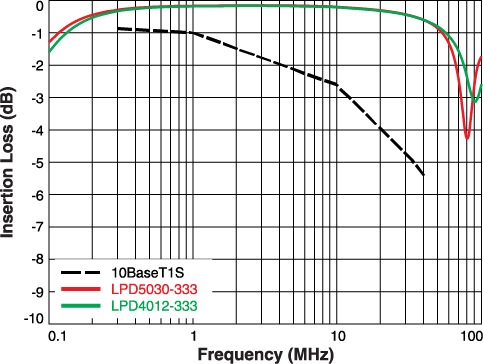
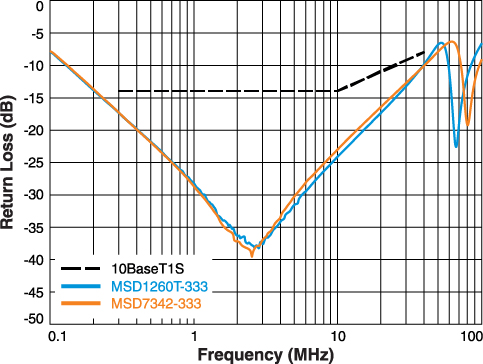
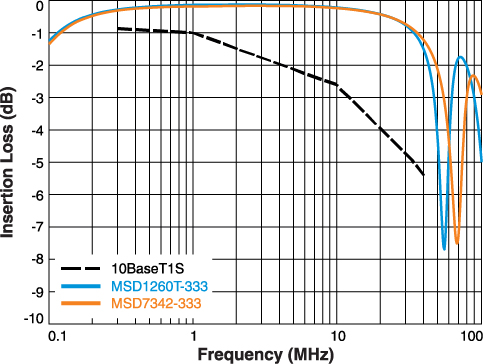
To validate the performance of these components in 10BASE-T1S PoDL applications, the schematic in Figure 2 was implemented. On the PHY path, a Coilcraft 1210ETH-244 was used as a data only common mode choke. On the PSE / PD path, the different components in the table were connected in common mode / differential mode. Return Loss (Sdd11) and Insertion Loss (Sdd21) were then generated between the microcontroller differential pair and the data point differential pair.
|
Return Loss (Sdd11)
.jpg?lang=en-US "doc1702_returnloss-LPD") |
|
Insertion Loss (Sdd21)
 |
|
Return Loss (Sdd11)
 |
|
Insertion Loss (Sdd21)
 |
100BASE-T1 Solutions — 100 Mbps High Speed
What is 100BASE-T1S?
100BASE-T1 is a single pair Ethernet (SPE) standard that provides 100 Mbps full-duplex communication with a maximum length of 15 m over a single twisted pair. It is designed primarily for automotive networks, but it is also adapted to connect local sensors or machines to nearby controllers in industrial or building systems.
Typical Applications — 100Base-T1 with Power over Data Lines (PoDL)
Similar to 10BASE-T1L and 10BASE-T1S, the 100BASE-T1 standard supports PoDL, allowing both data and power to be transmitted on the same pair. This eliminates separate power cables and reduces overall solution size. When both data and power need to be transmitted over the same pair, power injection chokes are used to couple DC current onto the line without degrading the high speed data signal. A common mode choke with AC coupling capacitor is there to provide EMI suppression and isolation (Figure 8).
Figure 8 – PoDL power injection is differential using a single bus
| |
Part Number |
Inductance (µH) |
DCR max (Ω) |
Max Area (mm²) |
Isat (A) 30% |
Irms both windings (A) |
Max Temp (Cº)
|
AEC |
| Common Mode Choke |
1210ETH-204 |
200 |
4.25 |
10 |
— |
0.08 |
140 |
Y |
| Power Injection Choke |
LPD5030-153 |
15 |
0.298 |
23 |
1.17 |
0.85 |
125 |
Y |
| LPD5030-223 |
22 |
0.452 |
23 |
0.98 |
0.70 |
125 |
Y |
|
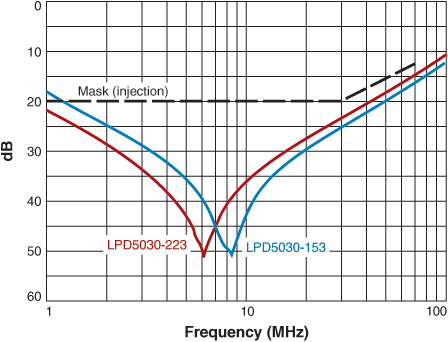
Return Loss (Sdd11)
 |
|
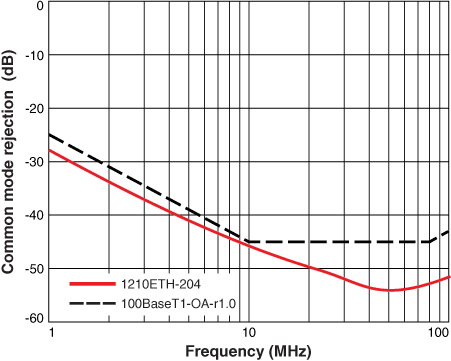
Common Mode Rejection (Scc21)
 |
|
Insertion Loss (Sdd21)
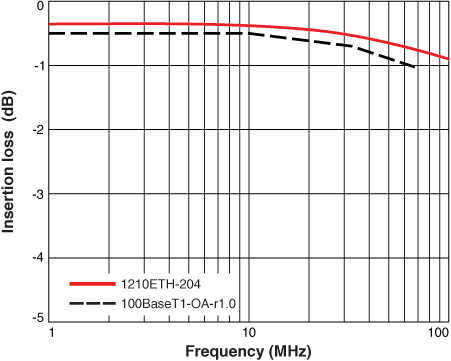 |
|
Return Loss (Sdd11)
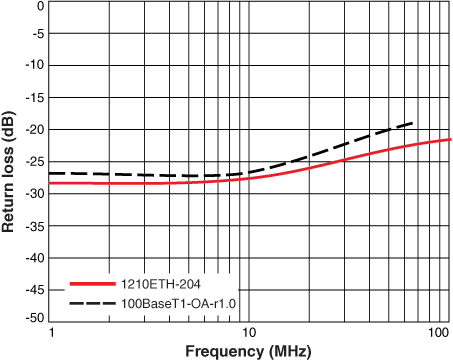 |
|
Differential to Common Mode Rejection (Ssd21)
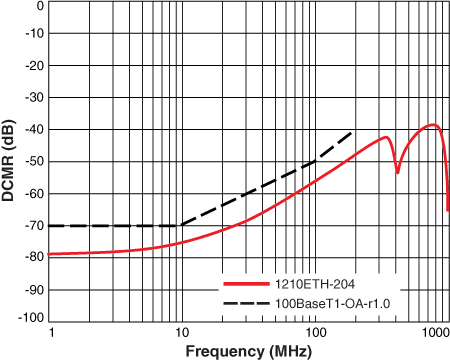 |
When PoDL is not used, the twisted pair carries only data signal. The design requires just a CMC with capacitors. This is the simplest implementation and is commonly used when external or onboard power is already available (Figure 9).
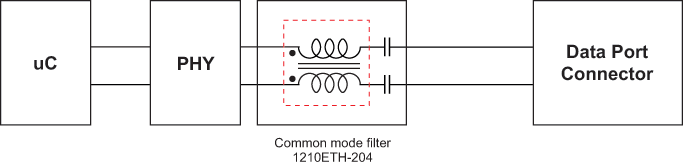 Figure 9 – PoDL solution does not require a transformer for isolation
10GBASE-T1 Solutions — 10Gbps Very High Speed
What is 10GBASE-T1?
10GBASE-T1 requires high speed signal transmission over a single twisted pair while maintaining signal integrity and isolation. Wideband transformers play a key role by providing galvanic isolation and supporting the wide frequency range needed for 10 Gbps communication.
For applications where a compact solution is important, our YA9308-AE Mini Wideband Transformer offers full isolation and high frequency performance in a small package, making it ideal for space-constrained automotive or industrial applications.
For designs that also need EMI suppression, our YA9219-AL Wideband Transformer with integrated common-mode choke combines high-speed signal transmission, isolation, and common-mode noise filtering in a single component. This integrated approach simplifies the layout, reduces board space, and ensures compliance with EMI/EMC requirements, while maintaining the high performance required for 10GBASE-T1.
| Part Number |
Pri L min (µH) |
Sec L min (µH) |
Pri DCR Max (mΩ) |
Sec DCR Max (mΩ) |
Turns Ratio |
| YA9308-AEC |
54 |
110 |
90 |
156 |
1 : 2 |
| YA9219-ALD |
127 |
65 |
350 |
150 |
1 : 0.714 |
Summary
Coilcraft offers complete magnetic solutions for various SPE applications:
- Our parts meet IEEE 802.3cg standards
- Validated with major PHY for reference designs from Texas Instruments, Analog Devices, etc.
- Solutions for both long reach with isolation and short reach with compact power injection
Target application in industrial automation, building control, and IoT where simplified cabling and long-range communication is needed.