What cleaning solutions can be used on Coilcraft's parts?
Coilcraft products are compatible with a wide range of commercial cleaning systems. For so many possible variations of neutralizers, surfactants, saponifiers, dispersants and
anti-foaming agents, it is not practical for Coilcraft to test or make recommendations. For this reason, we have standardized our testing on pure water and alcohol. Details
While Coilcraft has discontinued a small number of series, we will, when feasible, continue to support existing customers (with previous order history for this series). For many of these parts we have developed a newer
series that surpasses the performance of the discontinued part. If you search for the discontinued part on our web site, you will be guided to the replacement part.
A number of your parts are designated as "Not recommended for new applications." Does this mean that I won't be able to buy these parts again?
For these series, we will continue to support existing customers (with previous order history).
We used to buy 20% tolerance chip inductors from Coilcraft. Why are they are no longer available?
Manufacturing processes have consistently improved, and all of our ceramic chip inductors now fall into the 5% or better tolerance range.
These parts, in essence, are an improvement of the parts you used to buy.
Electrostatic discharge (ESD) testing is typically performed on active components such as transistors or ICs which have very thin ESD-sensitive semiconductor junctions. Coilcraft products are not typically susceptible to ESD damage. Therefore
we do not regularly test our products for ESD damage. In order to minimize risk of damage to other, more sensitive components, Coilcraft uses low ESD packaging wherever feasible.
Coilcraft components are subject to the Export Administration Regulations (EAR), but not listed with a specific Export Control Classification Number (ECCN) on the Commerce Control List (CCL). EAR99
items generally consist of low-technology consumer goods and do not require a license in many situations. However, if the proposed export of an EAR99 item is to an embargoed country, to an end-user of concern or in support of a prohibited
end-use, a license may be required.
How can I predict the changes in inductance, Q and SRF when mounting your RF inductors over a ground plane?
Modelithics has measured many Coilcraft RF inductor series with a variety of different substrate types and thicknesses. They have created global models that scale the substrate-sensitive parasitics for accurate simulations. Their models may be viewed at:
http://www.modelithics.com/mvp/coilcraft/
The effects of ground plane proximity depend on inductor geometry and test frequency, along with substrate thickness and dielectric constant. In many cases the effect is fairly small, but it can be significant in very tight-tolerance applications. The interaction of the magnetic field of an inductor with a metal ground plane is a complicated 3D E/M problem that requires careful measurement or simulation under specific application conditions. For this reason Coilcraft cannot quantify these effects in general.
Transformer data sheets don’t specify the inductance of the secondary winding. Could you please provide it?
We do not provide a specification for transformer secondary inductance. However, it can be calculated as primary inductance times the square of the turns ratio. For example, for a 2 : 1 transformer with a primary inductance of 10 µH, the inductance of the secondary is 10 µH × (0.5)^2 = 2.5 µH.
Why don't you specify the junction temperature on any of your data sheets?
Theta JA, Theta JC, Rja and Rjb are terms applicable only to active devices, such as integrated circuits. Inductors do not contain semiconductor material junctions and so do not have the same potential failure modes. Theta JA and Theta JC are
therefore not applicable to inductors.
Almost all of our parts are RoHS compliant, but not necessarily lead free. Any lead present in our RoHS-compliant parts is within allowed limits or is explicitly exempt in the RoHS directive.
Please read Coilcraft RoHS policy.
Are any Coilcraft parts qualified for medical, military or aerospace applications?
Coilcraft's Critical Products and Services Group offers products designed and tested specifically for these applications. Address your needs in an email to cp@coilcraft.com, or fax quote requests to.
What is the Moisture Sensitivity Level of Coilcraft parts?
All Coilcraft components have a Moisture Sensitivity Level (MSL) = 1, indicating unlimited floor life at <30°C / 85% relative humidity. To be classified MSL level 1, the component must pass the JEDEC J-STD-020 criteria of 168 hours in
a chamber with 85°C / 85% relative humidity.
During testing of our board, there is a buzzing sound from one of your inductors. Is this normal? Can it be eliminated?
Noise is usually due to a mechanical resonance in the component that is excited by the electrical conditions of the circuit, a phenomenon known as magnetostriction, and does not indicate a defect in the part. It is very dependent on the
application conditions and not always possible to eliminate by changes to the inductor alone. Changing the switching frequency is often the best way eliminate the noise. Applying a dampening material (electronic-grade encapsulant, potting
compound, etc.) may decrease the sound level produced or the increased mass of a larger inductor may dampen or shift the resonance to a different frequency.
My applications require the use of non-magnetic inductors. Which of your products are not magnetic?
All of our air-core inductors and many of our RF chip inductors are non-magnetic. Inductors with all ceramic cores like our CS, DS, HP, HQ,
PA, HC, CT, HS, and HT series contain no magnetic material.
All power products, shielded inductors, and chip inductors with ferrite cores (AF series) or ceramic/ferrite cores (LS series) are magnetic and do not meet your requirements.
Are there any outgassing issues with Coilcraft inductors?
There can be outgassing from any material under the right conditions but as a general rule outgassing has not been reported with Coilcraft parts in commercial applications and testing has not been required. For specialized applications where
outgassing is a particular concern, we recommend you contact our Critical Products group for products that have passed NASA low outgassing specifications
Your power inductors have numbers and letters on them. What do they mean?
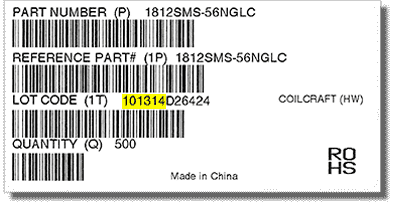
Part identification is specific to each product series. Refer to the part's data sheet for specific part identification markings. In the case of very small parts, a marking may not be used. In these cases, traceability to the original packaging information is required for accurate identification.
Power inductors, except for our smallest series are commonly marked with a three-digit code that corresponds to the three numbers that follow the dash in the
part number. This code refers to the value in nanoHenries, where the first two digits are the value and the last digit is the number of zeros. Therefore, 103 would be 10 plus three zeros, or 10000 nH, equivalent to 10 µH.
Why don't you provide polarity markings on all of your parts?
Unlike capacitors or diodes, inductors do not have a functional polarity and work equally in either direction, so polarity is not important in the vast majority of end-use circuits. On rare occasions, it has been reported that some inductors
perform better when mounted in one particular orientation, due to interaction with nearby components or ground plane conductors. Any asymmetrical performance is very much a function of the application, especially board layout. For further
comments on board layout see our sections on part spacing (minimum recommended inductor spacing) and shielding.
For any applications in which inductor polarity is critical please contact Coilcraft.
Yes, many Coilcraft parts may be potted, but it is difficult to generalize about the possible effects of potting or coating. Potential considerations include differing thermal expansion
coefficients of the potting compound vs. the inductor materials and changes in overall inductance and capacitance of the potted component vs. the original component. We recommend testing specific application conditions to determine the
effects of any proposed potting material.
What are the power ratings for your inductors? They are not specified on your data sheets.
There is a reason that we do not specify power ratings for our inductors. The more meaningful rating for inductors is the rms current rating. Inductor rms current ratings are derived by
applying dc or low frequency ac current and measuring the resultant temperature rise. This allows for an accurate determination of temperature rise vs rms current, which can easily be related to temperature rise vs power loss by Power Loss = Irms2 × DCR.
In practice inductor losses can include high frequency core loss, skin effect and proximity effect, which can add to the temperature rise. While these losses are application dependent and
should be verified in situ, Coilcraft offers tools for predicting frequency effects.
Core loss, conductor loss, and temperature rise can be estimated using the Core & Winding Loss
Calculator.
Can you provide UL and other Safety Organizations approvals for your products?
Coilcraft products are typically not certified by UL, CSA. TUV, CE or other agencies. However, we are ready to provide data necessary to help customers obtain approvals for their finished products. Safety standard listings generally apply to complete electronic assemblies such as power supplies, computers, modems, televisions, etc. and not specifically to the high-frequency transformers or inductors that Coilcraft manufactures.
More information
You don’t have an off the shelf transformer that exactly meets the requirements of my application. Can you provide some guidance to use one of your standard transformers in my application?
Many of our transformers can be adapted to a variety of circuit uses, by considering different connections for the windings. There
are, however, many variables to consider when adapting a component designed for one application for use in a different application.
Review the application note Using Standard Transformers in Multiple Applications to determine if one of our off the shelf products will work for you.
The shelf life of Coilcraft inductors depends on the inductor type and packaging and may be affected by high levels of humidity, pollution or other contamination. Shelf life is generally greater than one year if in original, sealed bag
packaging. If the bag is open or damaged, the shelf life may be affected.
The purpose of magnetic shielding is to reduce the amount of magnetic flux generated outside the inductor, in turn reducing the likelihood of radiating energy to nearby components or circuit board traces causing electro-magnetic interference
(EMI). Whether a shield is necessary depends on the proximity of other components and how field interaction would affect the performance of the circuit. Field interactions are quite challenging to model and measurement of the final circuit
design is recommended. In addition to reducing radiated fields, magnetic shielding typically contributes to the inductance of the component, helping achieve more inductance per given size of inductor.
Can I use tin-lead solder with your RoHS-compliant parts?
Coilcraft RoHS parts can be soldered using lead-based solders. As with soldering with lead-free solder, there are many factors that need to be taken into account: solder amount, flux, temperature limit of each soldered component, heat
transfer characteristics of the circuit board and component materials, and the layout of all components. Details
Can you provide a reflow soldering profile for your parts?
The optimal reflow profile for a circuit board assembly is dependent on the solder material, solder amount, flux, temperature limit of each soldered component, heat transfer characteristics of the circuit board and component materials, and the layout of all components. Therefore, there is no set profile for any of our parts. Refer to Soldering Surface Mount Components application note for a detailed discussion.
Can Coilcraft parts be hand soldered?
Most through-hole parts can easily be hand soldered. While our surface mount parts are designed to be reflow soldered, many may be soldered by hand. We do not recommend attempting to hand solder our small
chip inductors. Refer to Soldering Surface Mount Components application note for a detailed discussion.
How much space should be allowed between components to counter interactions?
The electro-magnetic fields created by inductors generally only interact with metallic surfaces or other inductors in very close proximity. The extent of interaction depends on a number of application factors, including the current through
the inductor, the axis of orientation to each other and the distance between them. The minimum spacing between inductors depends on the orientation to each other and the sensitivity of the end-use application to the interaction. Coilcraft
cannot advise on minimum spacing between inductors. Shielded inductors are designed to minimize this interaction. Orienting the coil axes of two inductors perpendicular to each other also helps to minimize interaction.
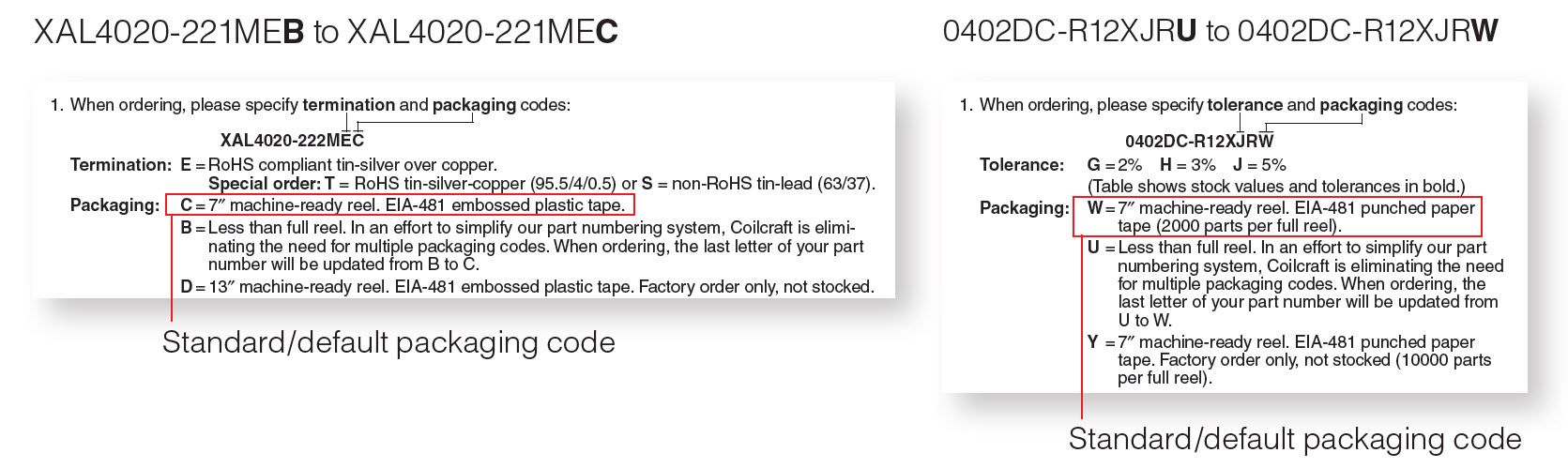
According to your data sheet, I can order my parts on a machine-ready reel, or in tape, but not machine ready. What is the difference?
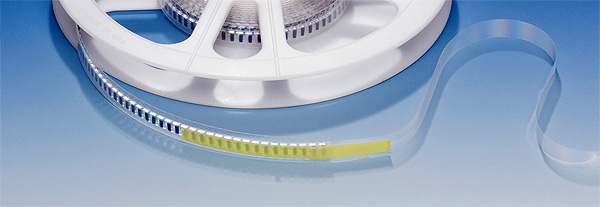
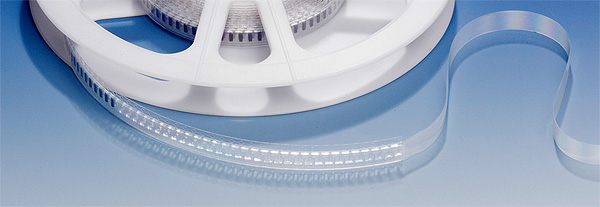
A machine ready reel has a tape leader that is not populated with parts. The leader is used to thread the tape through your pick and place machine. When you purchase a full reel of parts, the reel comes machine ready. If you
purchase less than a full reel, the parts come in tape on a reel, but the tape does not have the leader. A leader can be added for a nominal cost.
Why don't you specify thermal resistance for your products?
Thermal resistance is not specified for Coilcraft inductors because they are mostly open frame style and not solid, homogenous bodies like molded IC packages. These body styles have a variety of thermal flow paths and multiple heat
sources (winding and core) as opposed to an IC that may generate heat in a specific junction and conduct heat consistently throughout a solid body. You can calculate an approximate thermal resistance by dividing the temperature rise due
to Irms current (e.g. 40°C rise) by the power required to generate that rise.
(Power = DCR × Irms2) Rth (in °C/W) = 40°C ÷ (DCR × Irms2) where DCR is in Ohms and
Irms is in Amps.
Where can I find the weight for each of your parts?
The weight of a Coilcraft part is typically specified on the data sheet for the part. In the case of a part series, a weight range may be given that covers the entire series.